How block play changes
Children tend to move through rough stages with blocks. The ages vary a lot, and many children skip around between stages.
| Stage | What it looks like | Roughly when |
|---|---|---|
| Carrying and knocking | Moving blocks around, filling and dumping, knocking towers down | Around 1 to 2 years |
| Stacking and rows | Simple towers and long lines on the floor | Around 2 to 3 years |
| Bridges and enclosures | Two blocks with one across the top; walls that surround a space | Around 3 to 4 years |
| Patterns and buildings | Symmetry, repeating patterns, buildings with names and uses | Around 4 to 6 years |
| Planned projects | Towns, castles, copies of real buildings, builds that last for days | Around 6 years and up |
What makes a good block set
Classic unit blocks are cut in simple proportions. A square, a rectangle twice as long, a long piece twice that again, plus halves, triangles and arches. Because the sizes relate to each other, children discover fractions and balance as they build. Plain wood leaves the child to decide what each block is. A few painted or colored blocks add interest, but most sets work best with mostly plain pieces.
For young toddlers, choose larger blocks that cannot fit in the mouth. Small building pieces belong with older children.
Building challenges
- Build the tallest tower you can using only ten blocks.
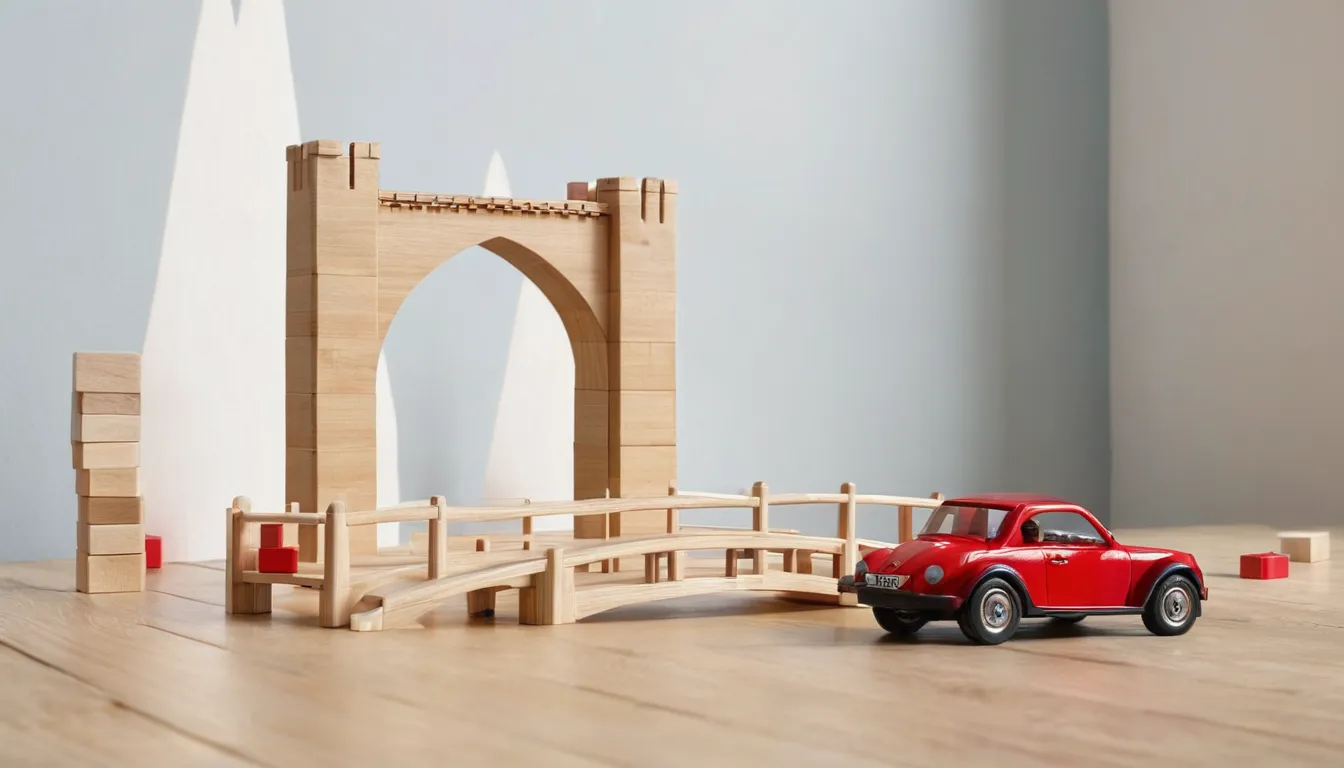
- Make a bridge that a toy car can drive under.
- Build a house for a small toy animal, with a door it can fit through.
- Copy a simple building from a picture, or from your own street.
- Build something that balances on a single block.
- Make a ramp and see how far a ball rolls.
Block games
Build and copy
One person builds a small structure from five or six blocks. The other copies it exactly. For a harder version, the builder hides the model and describes it in words.
Block bowling
Stand blocks up as pins and roll a soft ball at them. Count how many fall.
Take a turn
Players take turns adding one block to a shared tower. Whoever knocks it down starts the next one.
Talking about building
Words like over, under, beside, taller, shorter and balance come up naturally during block play. Describe what you see rather than praising: "You put the long block across the two short ones." Ask open questions, such as "What will happen if you add one more?" Let the child test it.
Storing blocks
Low open shelves, with each shape in its own spot, make cleanup a sorting game. A sturdy basket also works for small sets. Keep the floor near the block shelf clear so building has room to spread out. For cleaning and oiling, see caring for wooden toys.